Tuesday, September 27, 2011

Lisbon and Fatima, Portugal

 Another beautiful sunny day for an excursion ashore.  Before driving the 90 miles to Fatima, we took a “panoramic tour” of Lisbon which simply means a drive around with a guide saying on your left is the Rossio  Square and on your right is Edward VII Park.  Most of the city tours are like this, so most of my photos are taken through highly reflective bus windows…sometimes across the aisle windows.

I was in Lisbon two years ago and did a similar tour, but I am learning that Tour 1 is not Tour 2 which is to say you see a lot of the same things, of course, but you also are taken to different parts of a city depending on your tour guide.  I did see parts of Lisbon today that I did not see before, like a new section that has built up around the area where the 1998 World Exhibition was held.  This area includes high rise apartments, businesses, a huge aquarium, and this new modern train station designed by Spanish architect Santiago Calatrava whose idea was to make it look like fish bones.  It is really beautiful. 
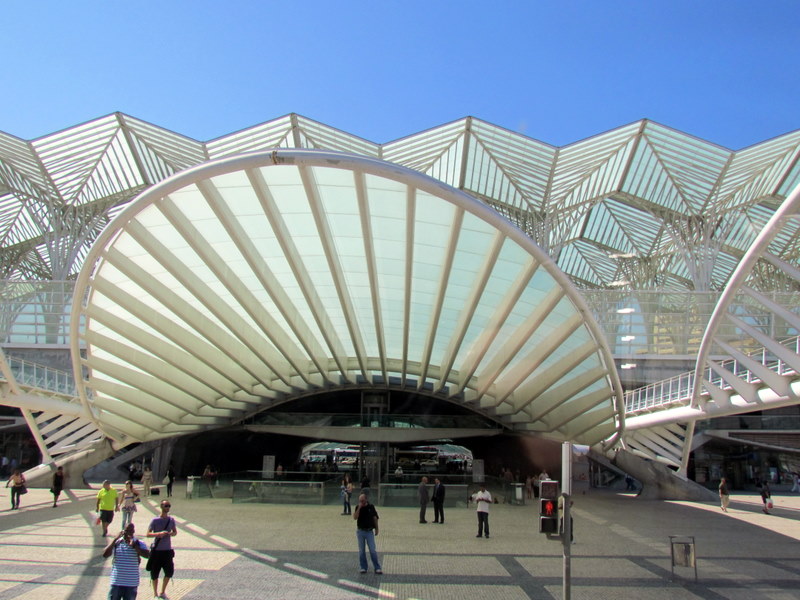
Despite its newness, graffiti is still seen.  Some of it is very well done and covers huge walls, making me wonder if these artists were commissioned to fill this concrete space.

I did observe that it must be Monday, wash day, since I saw a lot of laundry hanging out of the windows, even in really posh sections of the city.  This is a common sight throughout Europe, since they either don’t have driers, or if they do, they prefer the fresh air and sun to do the job.  This window was  in Alfama quarter, the oldest part of the city near the pier where we were docked.

I won’t repeat information or photos of Lisbon in this post.  If you are interested, look at my post in the archives.  To find it, look in the column on the right, find year 2009 in the Archives, click on the > and a menu will drop down, then select month of April,  another box will drop down.  Go down the list and click on “Lisbon and Esteril, Portugal”.
I was glad that we were going to Fatima on a Monday because it would not be as crowded as, say, on a Sunday. (The last time I arrived in Portugal it was Easter Sunday, so it was impossible to get into this mammoth square, much less the basilica, because of the thousands of worshipers.)


Through the center of this square, you see a path made of marble.  It is here that some make their way the entire length of the plaza on their knees as a sign of devotion or adoration.  Today, I saw this man doing that accompanied by a child.

There are three main structures on the plaza.  First is the basilica itself.  Inside is where the children who saw the apparition are buried.  The line in front of the altar are people who want to get a glimpse of the tomb.

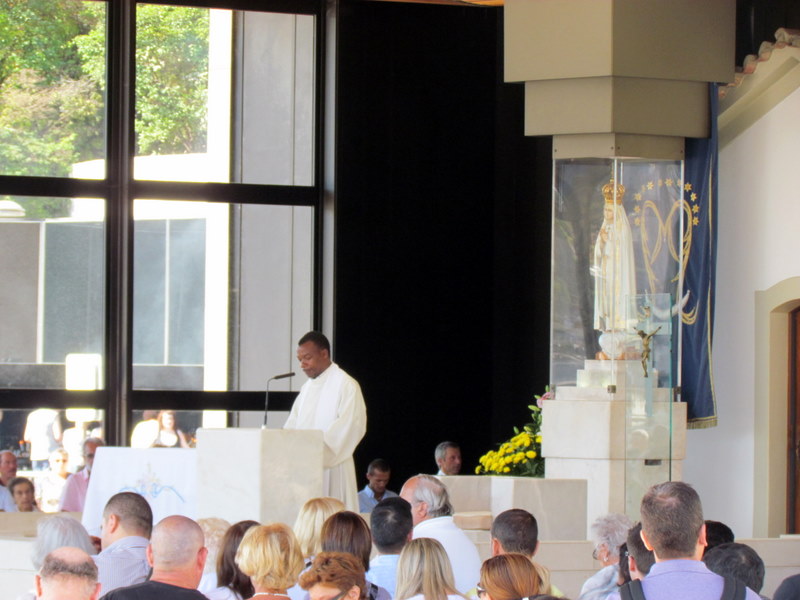
The second structure is built over the place where the children saw the apparition.  The marble column next to this priest who was leading the saying of the rosary as I went by is supposedly where the Blessed Virgin appeared.  It is reported that about four million people visit this Chapel of the Apparitions each year.
Next to this is a place where people light candles. Some of the candles are over six feet long.


Opposite the basilica next to a huge cross is a new, very modernistic church which can hold over 9,000 people.


At all religious places like this which draws millions of people every year, you will find an abundance of souvenir shops. Here’s one strip of them. There are many more.


They sell rosaries, candles, key chains, holy cards, statues, and so on. I’m sure collectively they make millions each year. 

I had a quick lunch in this little side café.

And then we were on our way back to the ship.


Sunday, September 25, 2011

Bruges, Belgium

Bruges, Belgium—September 23, 2011

The second stop on our cruise was ZeeBrugge, Belgium, the port for Bruges.  Between the 7th and 8th century a settlement was established on the banks of the Zwinn.  A port of international standing in the 13th century, Bruges fell into economic decline two centuries later when the river silted, and it was no longer a port.
Later, it became a city of great splendor, a city without rival as a center for the arts.  The architecture of Bruges,  styles spanning nine centuries often found in a single square, makes an essential contribution to the artistic patrimony of Europe. 

Wandering through squares, narrow cobble streets, parks, and along canals, you can see so much in a four hour walk and a thirty-minute canal boat ride.  Here are some of those sights:

                                                           Love Lake   


According to legend, since 1448 swans have been shown special favors here. Rebel citizens of Bruges holding Maximilian, Archduke of Austria prisoner, condemned his servant to death.  The Archduke consented to meet rebel demands, but in reprisal for the death of his servant, condemned the citizens of Bruges to take care of the swans until the end of time.  White swans belong to the city and are marked on the beak with a capital B and the date of birth.


 Bruges has elegant horses that pull the sightseeing carriages at a fast clip around the narrow streets. They know the way by heart and will not stop for man or beast.  They are considered more dangerous to pedestrians than the bicycles and cars.

Sometimes a dog can be seen riding along-side the driver.  This cute pooch peeked at me while his horse had stopped for a rest and a drink.

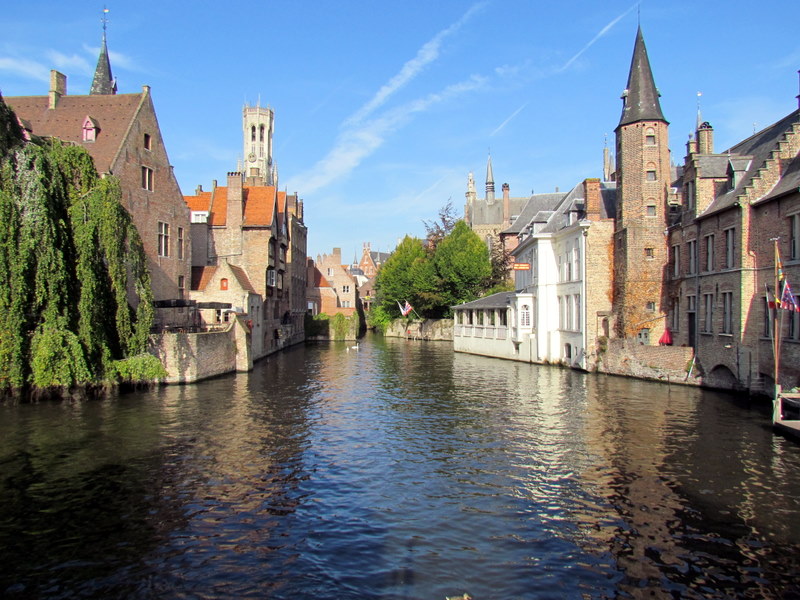
Here’s a scene called, The “Rozenhoedkaai”, which  attracts painters and photographers.  


The “Brug” was built as a fortress.  The famous Bell Tower, THE landmark of Bruges, can be seen rising behind it.


 On this square are the law courts built in classical style, the former Records Office/then police station, built in Flemish Renaissance style.  The Gothic town hall built in 1376 became the model for other town halls.

The Chapel of Blood completes this square.

Going through a gate a short distance away is the Main Square (Grand-Place).  A number of buildings with corbie-stepped gables flank the square.  These were originally guildhalls. 

Two magnificent houses face this square, as well as one house known as the “cat house” because of this stone cat on the roof which marks the spot.


You can see so many architectural delights as you go through the town by boat where you pass under a number of low bridges.


While riding on one of these boats, I even saw a doggie in a window watching the tourists go by.

Too bad I didn't see him soon enough to get a full view of his face.

I had some time  to window shop to look at famous Belgian Chocolate which was tempting me at every turn.


Lace is still made here.  The most sought after Bruges lace is created with the “sorciere” stitch which requires from 300 to 700 bobbins.  Like those wooden shoes, lace is mostly machine-made these days, although a few still know how to do it.

After walking over 5 miles, I was ready for lunch.  I found this wonderful little restaurant on the narrowest street in the city.  It was called, Maliesherbes, and seated only 16 people.  I later learned that this little restaurant is featured in a series of novels written by someone named Aspe.  That’s all I got, no first name, nor any titles, but I will find out more about this when I get home.


I had a delicious salad, a tasty tureen of fish soup with cheese, and a glass of wine.  This photo maybe doesn’t look appetizing, but believe me it was the best meal I have had on this trip. 


On our walk back to the bus through a park, I saw these girls enjoying a picnic and the early fall weather.


This day trip ranks up there as one of the best I have ever experienced.


Saturday, September 24, 2011

Cruising on the Norwegian Sun

This is the fifth day of our cruise which began in Copenhagen, Denmark, and will end at Port Canaveral, Florida.  During the first week, we have scheduled stops at several ports before we sail across the Atlantic.  We first sailed north from Copenhagen to the North Sea, where we turned south.  I was surprised that this part of the voyage was so smooth.  I always thought of the North Sea as very turbulent.  I guess it is sometimes, but it was calm as we sailed over wavelets of only .5 to 1.5 feet.
We have gone through the English Channel to the Atlantic.  Here’s a map of where we were this morning…off the coast of France.


Since entering the Atlantic, the waves have gotten higher.  You can see the effect by looking at this wave in the aft deck pool.

Amsterdam and Environs—September 22, 2011

Our first port of call after a day and two nights of cruising was Amsterdam.  I had chosen to go on a full day excursion which included a walking tour of an outside museum of wind mills in Zaanse Schans, a typical tourist visit to a wooden shoe maker, a walking tour of Edam, a stop and lunch in Vollendam, and then a combined driving tour and walking tour of Amsterdam.

What a great day!  We had picture perfect weather (literally)—sunny with temperatures in the low 60’s.  More importantly, we had a fantastic guide whose love of his country and city was evident as he described history, buildings, culture of the various places we visited.

Zaanse Shans

Zaanse Shans is a delightful old hamlet a few miles outside of Amsterdam on the banks of the River Zaan.  It is now an outside museum which gives the feeling of  stepping back in time.  Over the centuries, more than a 1,000 little windmill factories flourished along the River Zaan.  The windmills were used to saw wood, mill grain, crush oilseeds for linseed oil, and many other uses.  Here are three that served the purposes just listed:


Others, like the smaller windmill below, were used to pump water out of the lowlands to provide drain the land.


While at Zaanse Shans, we watched a demonstration of how wooden shoes were made, not by hand, but by using power lathes that follow models to carve shoes.  The one on the right carves the outer shoe from a block of wood, then the one on the left cuts out the interior wood.  It took only five minutes to make a shoe.  Of course they sell these shoes and other souvenirs.  Plus they charge 50 Euro cents to use the bathroom. The money from all of these ventures is used to maintain the outdoor museum and to preserve wind mills.


Edam
Edam was the next stop.  For most people, Edam is synonymous with cheese, as the popular round cheeses have been exported to all corners of the world for centuries.


But this town has much more to offer than just cheese.  It is a town with a rich history, lovely facades, squares, bridges, canals, and dogs.  Here’s a sample:


Vollendam

A few short miles away was Vollendam where we went mainly for lunch.  It has a place to park buses, many restaurants, and souvenir shops. None of which Edam had.  Some people just have to shop these junk shops.

I didn’t buy any lunch or junk.  I had brought my lunch, so I walked out on the dike and had a picnic.


I share my lunch with several little birds like this one.  I’ve never seen a bird with a polk-dotted breast.  Can anyone identify this bird?

While there, several boats came and went in the little port, some of which moored right in front of me.  Some were ferries that were going back and forth to Marken Island, just off the coast from here.

This cute little dog was being walked (yanked) along the dike. 


Just so you can picture how small he was, here he is next to his owners’ legs.


Amsterdam
After a refreshing break on the dike, we then drove back to Amsterdam to tour the city.
Of course we saw the ubiquitous bicycles everywhere, and beware if you get in their way.  Cars will stop; bikes won’t if you are in the bike path.


We also crossed over the canals with their tour boats, house boats, and lovely bridges.


We passed by Dam Square where street entertainers were gathering a crowd.


We passed by elegant shops and stores…and not so elegant ones like this one:
.
We also passed by apartments that have been taken over by squatters. These abodes are distinguished by colorful graffiti.


We also went by crazy sexy district…or red light district where there are red lights and girls in the windows.  If their curtains are drawn, they may be busy entertaining/working.

We passed many coffee shops. Our guide told use that coffee shops are really places where you can buy and smoke pot. The signs are always green and yellow. And, even though illegal, they are licensed by the city and are given a green city seal for coffee houses to show that they are legally illegal


We then did a walking tour through the University district to go to a surprising place called, “The Begijnhof”.  Under the guidance of an unmarried woman, other unmarried women came together to live in community. They were a quasi-religious community, vowing chastity and obedience to the head woman, but not poverty.  They lived in these magnificent apartments, and if they should take a lover or decide to get married, they had to leave.  They were not officially recognized by the Catholic church (I learned about a similar community in Bruges [that’s for tomorrow]).


We wandered through interesting streets, through inside passages where courtyards appeared, like this one, which was once part of an orphanage, but now is part of a museum.


One person on the tour who had worn her pedometer informed me that we had walked 6 miles today.  I can’t believe I did that!! Over coble stones, no less. But it is easier to do when it isn’t 90+ degrees souped up with 90+ humidity.
Since we have a sea day tomorrow before we arrive in Lisbon, I will catch up with a description of the visit to Bruges.